
If we are to define the stages of a reading approach, we must start by defining and agreeing on the concept of reading. Thus, we can understand the focus of each of the stages that make up the reading instruction model. For doing this, I have chosen two definitions that complement each other in the different aspects of reading. According to Kintsch (2005), reading can be defined as the recognition of written symbols, which serve as stimuli for recalling meaning built up through past experiences and further concentrating new meaning through the reader’s manipulation of relevant concepts already in his possession.
Figure 1.
Representation of the definition by Kintsch.
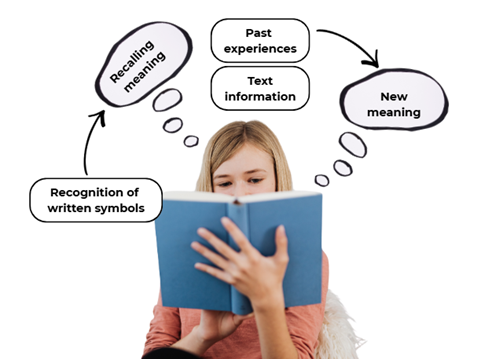
Note: Image adapted from Canva.
As stated by Guthrie (2012), reading is a purposeful and motivated process in which readers actively construct meaning by integrating prior knowledge, text information, cognitive strategies, and social interaction. While both definitions share common ground on the cognitive aspects of the reading process, such as using prior knowledge to approach the text and using strategies to construct meaning, the latter places the reading process within a social context and emphasises both motivation and social interaction.
Figure 2.
Representation of the definition by Guthrie.
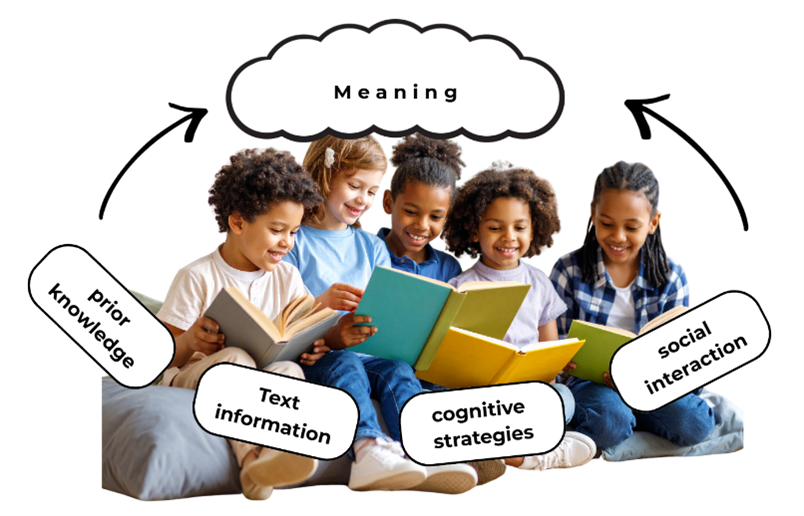
Note: Image adapted from Canva.
Consequently, the framework concept-oriented reading instruction proposed by John T. Guthrie was named like this to reflect the central position of concept knowledge in teaching reading comprehension. Following the experienced judgements of teachers and findings from research on reading, the framework has two main aspects:
- a) support for the cognitive strategies for knowledge construction during reading, and
- b) support for the motivational development of learners.
The first component of the CORI framework focuses on knowledge goals, in which key concepts of a topic become the main purpose for reading and learning. Research shows that conceptual learning goals are more motivating for students than isolated skills or performance goals. For instance, comprehension strategies like questioning become more engaging when they are taught within meaningful and interesting contexts.
The second component focuses on fostering motivation, such as curiosity, enjoyment, challenge, and confidence. Students are encouraged to observe real-world objects and events and connect them to their reading. A strong emphasis is placed on student choice, allowing learners to select subtopics, goals, and materials that interest them. Sustained exploration of personally meaningful concepts helps students deepen their understanding while gradually developing more advanced reading strategies.
Based on these two components, the Concept-Oriented Reading Instruction (CORI) framework, designed by John T. Guthrie, consists of four primary instructional phases intended to foster both reading engagement and comprehension.
Adapting CORI for EFL settings in the Reading in Action Series
While CORI was originally intended for native speakers of English, research indicates it can be successfully adapted for English as a Foreign Language (EFL) settings to help students become more strategic readers. Thus, the Reading in Action series has organised the contents and activities of each book following the four phases of the model and the traditional stages of pre-reading, while-reading and post-reading.
The reading lessons for each of the books in the series will adopt the Concept-Oriented Reading Instruction (CORI) and will have two main objectives:
- to explicitly teach reading comprehension strategies for the texts that students will choose to read, and
- to provide classroom practices to engage readers.
Phase 1: Observe and Personalize
This initial phase aims to develop students’ awareness of their personal background knowledge. Teachers use thematic units (such as food, health, or technology) to promote personal engagement and build metacognitive awareness of the activities required to learn a language.
- Activating prior knowledge:
During the first lesson, students will relate the text they have chosen to their experiences. They will form groups of four students and will comment if they have had any experiences related to the topic or if they have seen, learnt, watched or heard about the topic before.
Figure 3.
Example of questions to activate prior knowledge.
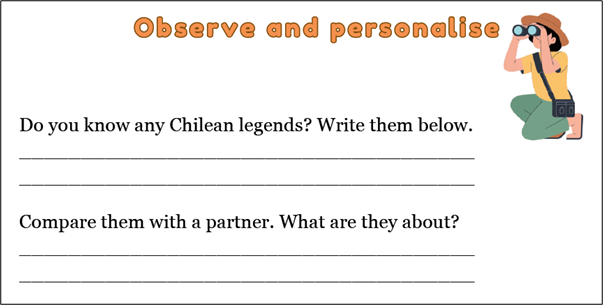
Note: Image taken from Reading in Action—Legends.
- Questioning
Students will ask multiple questions about the topic for group discussion. They can identify questions that can be answered by reading.
Figure 4.
Example of questioning.
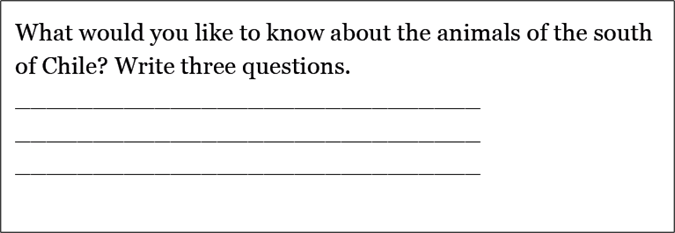
Note: Image taken from Reading in Action—Southern animals.
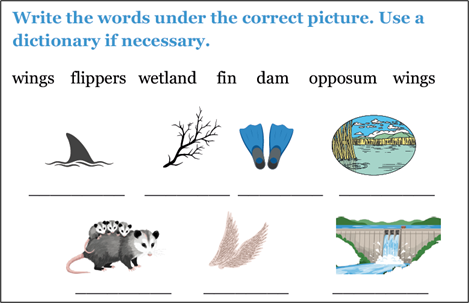
1.3 Vocabulary
Students will work on the meaning of low-frequency words included in the text. This component is not originally in the CORI framework, but it has been added to the books for EFL students to get familiar with the key vocabulary they will encounter. The books also include a glossary with Spanish translations to support students during reading.
Figure 5.
Vocabulary exercise during the pre-reading stage.
Note: Image taken from Reading in Action—Southern animals.
Phase 2: Search and Retrieve
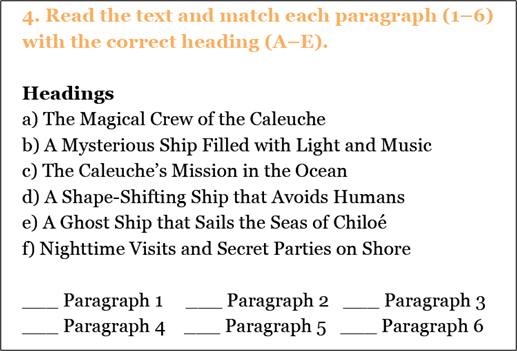
During this stage, students learn to identify the specific information they need or want to read, allowing them to disregard irrelevant text. Classroom practices include skimming and scanning, previewing questions, and building concept maps—such as charts, lists, or diagrams—to help retrieve information quickly and efficiently.
Figure 6.
Exercise for students to identify main ideas.
Note: Image taken from Reading in Action—Legends.
Phase 3: Comprehend and Integrate
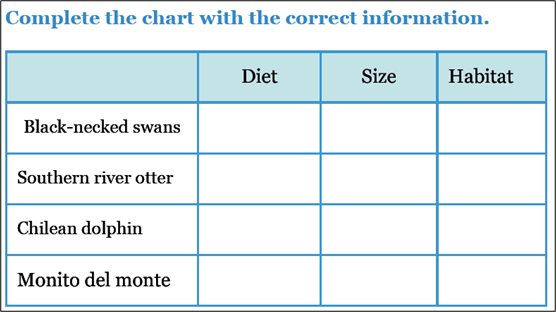
This phase focuses on explicit instruction of specific strategies for understanding informational texts. In this phase, the teacher uses scaffolding techniques to show students how to identify important ideas in a single text, and she modelled how to combine ideas from multiple texts. Specifically, students practice identifying topics, recognizing important ideas, and writing summaries about what they read.
Figure 7.
Exercise for students to combine ideas from multiple texts.
Note: Image taken from Reading in Action—Southern Animals
Phase 4: Communicate to Others
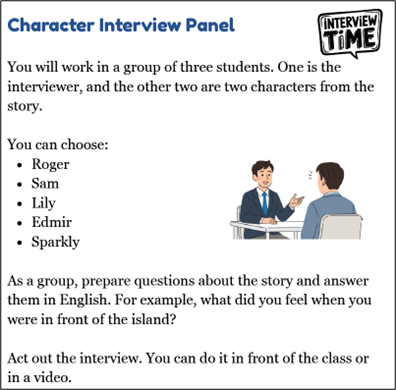
During the final phase of instruction, students compose a report to communicate what they have learnt to 0ther students. In this phase, students are taught how to take notes and how note taking differed from copying. Organizing notes into an outline is taught with teacher modelling and students sharing their organizational schemes with other students. Composition of the reports is taught with a process approach of drafting and revising. Peer-peer interaction was encouraged at designated periods to enable students to compare, reflect, criticize, and elaborate their writing.
Figure 8.
Example of a group project for students to share ideas about the text they have read.
Note: Image taken from Reading in Action—Roger and the secret mission.
References
Kalsum, U., Suwarno, B., & Dharmayana, I. W. (2018). THE EFFECT OF CONCEPT ORIENTED READING INSTRUCTION (CORI) STRATEGY TOWARD STUDENTS’ READING COMPREHENSION. JOALL (Journal of Applied Linguistics and Literature), 2(1), 60–71. https://doi.org/10.33369/joall.v2i1.5870
Kintsch, E. (2005). Comprehension. In S. G. Paris & S. A. Stahl (Eds.), Children’s reading: Comprehension and assessment Mahwah, NJ: Lawrence Erlbaum Associates.
Guthrie, J. T., Wigfield, A., & You, W. (2012). Instructional contexts for engagement and achievement in reading. Routledge.
Guthrie, J. T., Wigfield, A., & Perencevich, K. C. (2004). Motivating reading comprehension: Concept-oriented Reading Instruction. Routledge.
Guthrie, J. T. (1994). Concept-Oriented Reading Instruction: An integrated curriculum to develop motivations and strategies for reading. Reading Research Report No. 10. National Reading Research Center, 10. https://files.eric.ed.gov/fulltext/ED366927.pdf
Sugiarto, D., Indrawati, I., & Meygita, R. (2021). Improving Students’ Reading Comprehension Text through Concept-Oriented Reading Instruction (CORI). EEdJ English Education Journal, 1(1), 30–38. https://doi.org/10.32923/eedj.v1i1.1789
Vongkrachang, S. (2015). CORI: Explicit Reading instruction to enhance informational text comprehension and reading engagement for Thai EFL students. PASAA, 49(1), 67–104. https://doi.org/10.58837/chula.pasaa.49.1.3